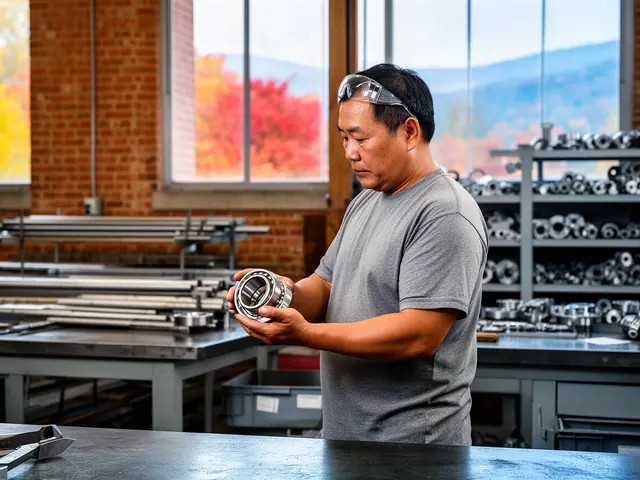
Funding for Catawba County, NC job shops, fabricators and furniture and cabinet plants: CNC cells, router replacement, metal shop equipment, buying versus leasing, and the rigging and tooling around a machine.
At a glance
- Fabricated metal manufacturing
Fabricated metal product manufacturing, Catawba County, NC: 35 establishments, 1,078 employees (CBP 2023)
- Furniture and cabinet manufacturing
Household and institutional furniture and kitchen cabinet manufacturing, Catawba County, NC: 79 establishments (CBP 2023)
- Manufacturing payroll
Manufacturing, Catawba County, NC: $1.31 billion annual payroll, the largest of any sector (CBP 2023)
Machine Shop Financing for a Catawba County, NC Job Shop Adding a CNC Cell
Fabricated metal product manufacturing, the Census code that includes machine shops, had 35 employer establishments in Catawba County, NC in 2023, with 1,078 paid employees and $65.9 million in annual payroll (County Business Patterns 2023). Commercial and industrial machinery repair added 19 establishments, and machinery, equipment and supplies wholesalers 53.
A job shop adding a CNC cell, a vertical machining center with a pallet changer or a robot loader, for instance, is buying capacity before it has the orders to fill it. Partners want the dealer quote, the shop's current utilization and, ideally, the customer work the cell will take on. A letter of intent or a purchase order from a customer carries weight.
Spindle hours from existing machines tell their own story. A shop running two shifts on its current mills can show that the work is already there; one running half a shift is asking a partner to fund growth on projections, which is a different request.
CNC Machine Loan for a Furniture or Cabinet Plant Replacing a Router
Household and institutional furniture and kitchen cabinet manufacturing had 79 establishments in Catawba County, NC in 2023, with 8,215 paid employees and $433.9 million in annual payroll (CBP 2023); upholstered household furniture alone had 58 establishments. Furniture and cabinet plants run CNC routers, nested-based machining centers, edge banders, panel saws and boring machines.
Replacing a router is often about accuracy and speed of setup, and the old machine may have trade-in or resale value. Illustration only, invented figures: a cabinet plant finances $210,000 for a router over 84 months at an invented annual rate of 9.5%. For the plant that means roughly $3,432 a month and $78,308 of interest over seven years (our arithmetic). Bluepeak's article on funding a new CNC line walks through the whole purchase.
Metal Shop Loans for Press Brakes, Lasers and Welding Equipment
Metal shops finance press brakes, fiber lasers, plasma tables, saws, welding positioners and robotic welding cells. Lasers and press brakes hold value well when maintained, and partners can usually value them from the dealer quote or, for used machines, from the serial number and hours.
Welding cells with robots need fixtures, guarding and programming time, which some partners count as part of the cell.
Power and air matter: a new laser may need electrical service upgrades, an assist-gas supply and a chiller. Those costs should appear on the quote or on a contractor's bid, so the request covers the whole installation. Electrical upgrades in North Carolina are done by licensed electrical contractors; the NC electrical licensing guide explains the classes.
Business Loan for a Machinery Purchase Versus an Equipment Lease
A loan to buy a machine makes the shop the owner from day one; the machine is collateral until the loan is paid off. A lease keeps ownership with the lessor and may end with a buyout, a return or a renewal. Payments on a lease can be lower in some structures, but the total cost and what happens at the end decide which is better for a given shop.
Tax treatment differs too, and a shop should ask its accountant how each option would be recorded and deducted. The lease or finance article compares the two for a forklift and a saw.
How Does Leasing Machinery Work for a Shop With Seasonal Orders?
Machinery leases can sometimes be structured with payments that vary over the year, such as smaller payments in slow months and larger ones when orders peak, if the lessor agrees. A shop with uneven orders should ask about this rather than assume a level payment is the only option.
Shops whose orders swing also benefit from a line of credit for materials, kept separate from the machine payment. Bluepeak's article on credit lines and 60-day invoices covers that side.
Rigging, Tooling and Training: Costs Around the Machine Itself
The machine price is not the whole cost. Rigging and transport, foundations or anchoring, electrical and air hookups, tooling and fixtures, software and post-processors, and operator training can add a large share to the quote. Some partners finance these soft costs with the machine when they are on the same invoice; others fund only the hardware.
Ask before ordering. A request that lists every cost is cleaner than one that comes back later for the extras. Related: construction, auto repair, equipment financing, working capital, all industries and the Hickory, NC page.
By Bluepeak Lending Group · Updated